Why counting procedures no longer works – and what modern specialist training needs instead
Introducing workplace-based assessments (WBAs) is not a major technical hurdle. The real challenge is human in nature: it’s about building new habits, changing the culture, and reducing the fear of evaluation. Adi Marty, our expert in competency-based training, has summarized the most important insights from practice.
The Real Problem: Forgetting
The tool is right in your pocket. The willingness is generally there. And yet the assessment doesn’t happen — simply because people don’t think of it. Forgetting is the biggest enemy of the new habit, not a lack of motivation. Understanding this is the first step in the right direction.
Condition 1: The concept must be solid
Before any tools are introduced, everyone involved — trainees and supervisors — must understand what EPAs and programmatic assessment mean. Even  more importantly: They must find the concept meaningful. This cannot be achieved with a one-time introductory session. The following are helpful:
-
Short presentations for the entire team, e.g., during department meetings
-
Interactive workshops with concrete case studies
-
Short explanatory videos that people can watch on their own
Condition 2: Immediately after the task — or not at all
A WBA should not have to be conducted in the evening after a long shift. It must be integrable into the workflow — and in such a way that it takes less than a minute. If this hurdle is too high, it won’t happen, no matter how good the intentions are.
preparedEPA is designed precisely for this: conducting an assessment together immediately after a task. No flood of invitation emails to supervisors (who then respond only with a delay—if at all)
Best Practice 1: No one is solely responsible
When it comes to performance reviews, trainees and supervisors are in the  same boat. Both parties are responsible for ensuring that feedback sessions take place. It doesn’t matter who asks first. What matters is that both remind each other until the new habit is established.
Recommendation: Make this explicit within the team. Explain that mutual reminders are expressly encouraged and a sign of a strong learning culture.
Best Practice 2: Show statistics – make teaching visible
In regular reports, show who has documented how many WBAs. This has an impact on several levels:
-
Trainees see their activity in comparison, which motivates them mutually
-
Supervisors who are particularly committed to teaching become visible
The preparedEPA dashboard provides exactly these analyses – without manual processing.
Best Practice 3: Actively Use Data
Documented assessments only deliver their full value if they are actually used. Specifically, this means:- Mentoring sessions: Specifically address learning objectives from previous assessments and follow up—“Where do you stand with this learning objective?”
- Performance reviews: Use competency profiles as a data-driven foundation instead of subjective assessments
- HR decisions: Who is allowed to work night shifts? Decisions should be based on documented data, not gut feelings
Best Practice 4: Build small habits
The classic book Atomic Habits sums it up: Big changes come from small, consistent actions. A concrete example from everyday clinic life:
Every morning, just before you start, check the app to see which trainees you’ll be working with today. What is their current competency profile? Which EPAs are scheduled for today? Which learning objectives are still pending?
This takes two minutes and sets a mindful tone for the day — with a focus on targeted learning opportunities.
Best Practice 5: QR stickers as physical triggers
Here’s one of the most practical innovations: stickers and posters with QR 
codes that link directly to a specific EPA in preparedEPA. Just point your smartphone camera at them — and you’re immediately taken to the assessment process for that EPA.
The idea: The stickers are placed exactly where the respective EPA takes place. 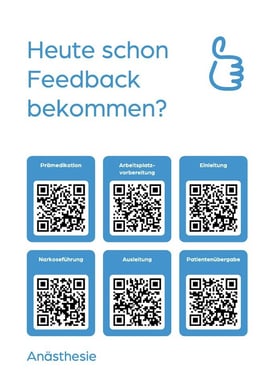
-
Anesthesia preparation: Stickers for “Perform intubation” or “Induction of anesthesia”
-
Surgical consultation: Stickers for “Informational consultation”
-
Echocardiography room: Stickers for “Performing a cardiac echocardiogram”
-
Break room / Office: A4 posters featuring multiple EPAs—for those five-minute breaks in between.
A4 posters featuring multiple EPAs—for those five-minute breaks in between.
The sticker isn’t just a gimmick. It’s a concrete, physical reminder that constantly prompts both parties to consider the possibility of an assessment—without opening an app, without searching.
👉 You can create the EPA posters and stickers yourself: tools.prepared.app
Best Practice 6: Short, but frequent
A WBA doesn’t require a long conversation. One to four minutes is enough to conduct a meaningful feedback session and identify a specific learning objective. It’s better to have five short feedback sessions per week than one in-depth session per quarter.
This also changes how trainees perceive the process: it’s not about an exam, but rather a brief, constructive exchange immediately following a task.
Conclusion in a nutshell
The more data points available, the more targeted teaching can be—and the clearer it is for trainees where they stand and what to do next.
Do you have questions about implementing preparedEPA at your institution? We’d be happy to help you plan the first steps.
